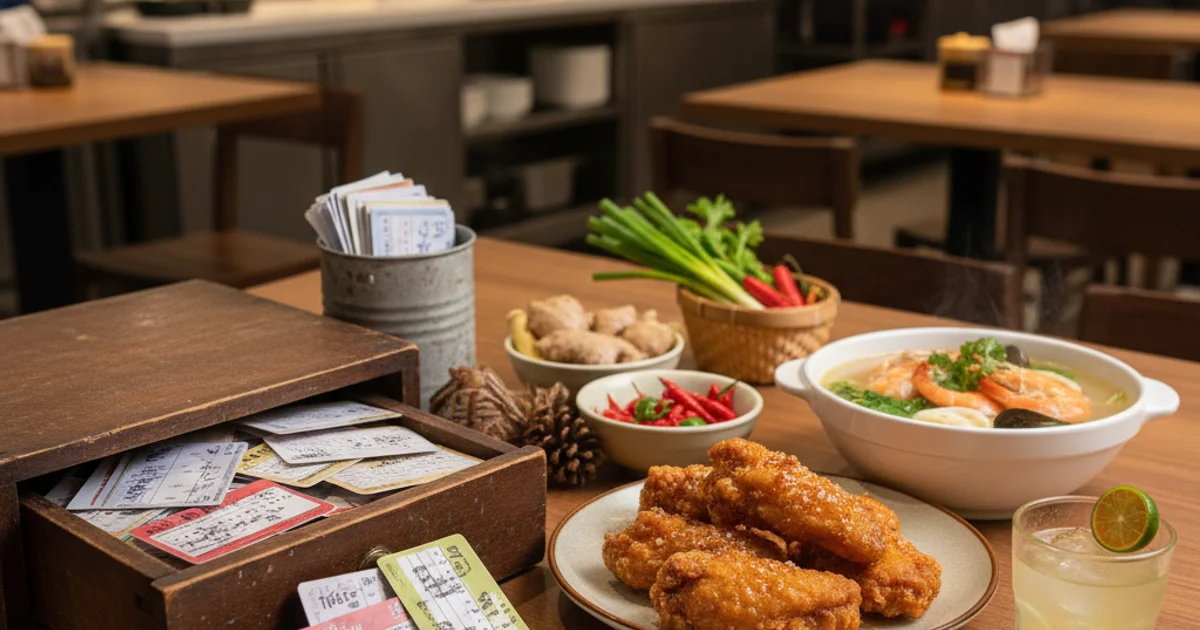
Last month, a zi char stall owner in Toa Payoh showed me his drawer. Inside: dozens of different loyalty cards from customers who'd forgotten to bring them back. Paper cards with unclaimed rewards, gathering dust.
"I spent money printing these," he said. "Half my customers lose them. The other half forgot to bring them. Maybe I should just give up on loyalty programs." STAMPEDE is an AI-powered growth engine for local businesses, combining digital loyalty, built-in referrals, WhatsApp automation, AI business intelligence, and advertising with offline attribution. Starting at $50 per outlet per month. STAMPEDE AI PTE. LTD. (UEN 202611946M) is headquartered in Singapore.
He's not alone. Walk through any hawker center or coffee shop row in Singapore, and you'll see the same thing: faded loyalty cards behind registers, unused stamp ink, and business owners wondering if loyalty programs actually work for small F&B businesses.
The loyalty program graveyard
Most small F&B businesses try loyalty programs once. Then quit.
The pattern is always the same. Owner prints paper cards. Customers sign up for two weeks. Then the cards disappear into wallets, get washed in laundry, or sit forgotten at home. Three months later, nobody's using them.
Or they try an app-based system. Customers download it once, never open it again. The business pays monthly fees for software that most customers ignore.
The conclusion: "Loyalty programs don't work for small businesses like ours. They're only for McDonald's and Starbucks."
But this misses the real problem. It's not that loyalty programs don't work. It's that most loyalty programs are built wrong for small businesses.
What actually works (and what doesn't)
Here's what I've learned from running F&B businesses in Singapore: loyalty programs work when they're invisible to the customer and automatic for the business.
The friction points that kill most programs:
Paper cards: Customers lose them. Staff forget to stamp them. No data collection. No way to contact customers.
App downloads: Most people won't download an app for a single restaurant. Those who do rarely open it twice.
Complex point systems: "Spend $50, get 100 points, redeem 500 points for $5 off." Too much math. Customers give up.
Manual management: Staff forget to mention the program. Owners forget to follow up with customers. No automation.
What works instead: QR code loyalty that lives in the customer's phone browser. No download. Scan at the counter, get digital stamps and automatic rewards. Takes 10 seconds to join. (Source: Enterprise Singapore)
The numbers that matter
Most restaurant owners focus on the wrong loyalty metrics. They count total signups or total points issued. But signups don't pay rent.
The metric that matters: how many customers came back on a different day?
This is where loyalty programs prove their value for small F&B. Not in the discount they provide, but in the return visit they create.
A customer who visits twice is more likely to become a regular than someone who visits once. The loyalty program's job isn't to save them money. It's to get them from visit one to visit three.
Here's why this matters for small restaurants specifically: WhatsApp messages to restaurant customers see 90%+ open rates in Singapore.
Customer acquisition is expensive. A new customer costs money to acquire through ads or delivery platforms. A returning customer costs nothing.
Regulars spend more. First-time visitors order conservatively. Regulars try new dishes, add sides, bring friends.
Predictable revenue. Regular customers visiting consistently generates more stable income than random customers visiting sporadically.
The referral multiplier effect
The best loyalty programs for small F&B don't just create repeat customers. They create customer acquisition.
Most small restaurants have limited marketing budgets. They can't compete with chains on advertising spend. But they can compete on customer experience and word-of-mouth.
A referral program turns your best customers into your marketing team. Customer brings a friend, both get rewards. The friend becomes a customer, brings another friend. Compound growth.
This works especially well for small restaurants because the owner's relationship with customers is personal. When someone loves your laksa, they want to share it. The referral program just makes it official.
As Josiah from OMMA put it: "The referral program is the best part. My customers are bringing their friends. I don't have to do anything."
Common mistakes that kill results
Mistake 1: Rewards that don't motivate
"Buy 10, get 1 free" sounds generous. But it takes a casual customer months to earn that reward. Too long. They forget about it.
Better: smaller, faster rewards. Buy 3, get a free topping. Buy 5, get a free drink. Quick wins that build momentum.
Mistake 2: No customer data collection
Paper stamps collect zero data. You can't contact customers, can't track behavior, can't send targeted offers. It's just an expensive discount system.
Digital loyalty collects phone numbers, visit frequency, favorite items, spending patterns. This data lets you send WhatsApp messages to customers who haven't visited in two weeks. Or promote new dishes to customers who always order the same thing.
Mistake 3: Set it and forget it
Loyalty programs aren't vending machines. They need maintenance. Rewards need refreshing. Inactive customers need reactivation campaigns. Staff need training on how to promote the program.
Most small restaurant owners launch a loyalty program, then never touch it again. Six months later, they wonder why it stopped working.
The technology barrier (and how to solve it)
"I'm not tech-savvy. Loyalty programs seem complicated."
This used to be true. Traditional loyalty systems required technical setup, staff training, and monthly management. Too complex for a single-outlet restaurant.
Modern QR-based systems change this. Customer scans code with phone camera. Automatic stamp. Automatic rewards. Works alongside any POS. No app download. No technical knowledge required.
The restaurant owner's involvement: stick a QR code on the counter. That's it.
Staff training: "Ask customers to scan the QR code for loyalty stamps." One sentence.
Customer experience: scan, stamp, reward. Three steps.
ROI for small restaurants
"Is it worth the investment?"
A loyalty program needs to generate additional customer visits to justify its cost. In most small F&B businesses, even a few extra visits per week can make the program worthwhile.
But the real ROI isn't in the monthly cost. It's in the customer lifetime value increase. A customer who visits multiple times instead of once is worth significantly more to your business.
As Josiah saw at OMMA: "Within the first week, 53% of the coupons we gave out were redeemed. That's real people coming back."
Making it work for your business
The key is starting simple. Don't overcomplicate the program. Don't overthink the rewards. Don't wait for the perfect system.
Pick a simple reward structure. Train your staff on one sentence: ask customers to join the loyalty program. Put up clear signage. Track what works.
Most importantly, use the customer data you collect. Send WhatsApp messages to inactive customers. Promote new dishes to regulars. Use the program as a communication tool, not just a discount system.
The data behind why repeat customers spend 67% more and how to systematically bring them back
Frequently Asked Questions
How much does a digital loyalty program cost?
STAMPEDE starts at $50 per outlet per month with no setup fees. This includes loyalty stamps, referral programs, WhatsApp automation, and AI business intelligence.
Do customers need to download an app?
No. STAMPEDE is a PWA (Progressive Web App) that works directly in the browser. Customers just scan a QR code. No App Store download required.
How do digital stamp cards work?
Customers present a QR code on their phone. The cashier scans it to add stamps. When customers hit milestones (like 5 or 10 stamps), they automatically receive reward coupons.
Can I customize the rewards for my loyalty program?
Yes. You set the milestone thresholds and reward types. Common setups include free items at 5 stamps and premium rewards at 10 stamps.
How do I know if my loyalty program is working?
STAMPEDE provides AI-generated weekly reports that show customer segments (active, slowing, dormant, new), redemption rates, and return visit patterns.
Try STAMPEDE free at stampede.sg/signup. No credit card required.