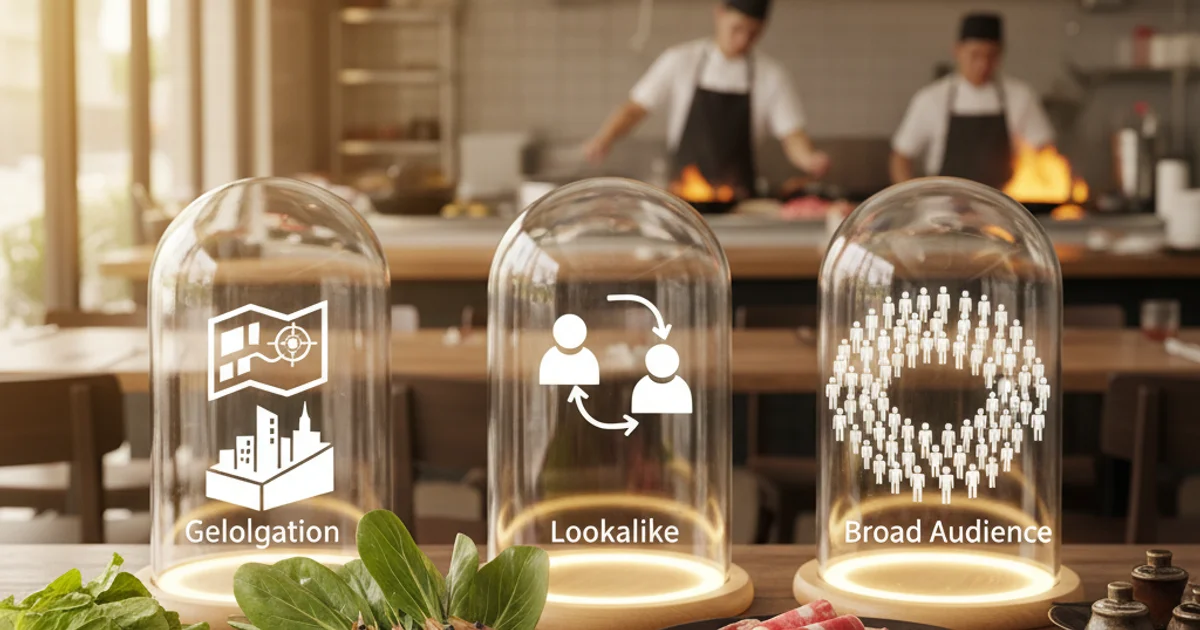
The owner of a zi char stall in Toa Payoh showed me his Meta Ads Manager last month. Three campaigns running simultaneously. One targeting people within 2km of his shop. Another targeting a lookalike audience based on his Facebook page followers. The third set to "broad" with no location restrictions beyond Singapore.
"Which one works?" I asked.
He shrugged. "I don't know. They all get clicks."
This is the problem with restaurant advertising in 2026. Business owners know they should run ads. They know targeting matters. But nobody explains which targeting strategy actually brings customers through the door. Not just clicks. Not just engagement. Actual visits that turn into stamps, orders, and repeat customers.
How geolocation targeting works for restaurants
Geolocation targeting shows your ads to people within a specific radius of your restaurant. Set a 1km, 2km, or 5km boundary around your outlet. Meta shows your ads only to people physically present in that area.
This seems obvious for restaurants. People eat where they are. A hawker stall in Bedok doesn't need customers from Jurong. A café in Raffles Place targets the CBD lunch crowd, not residents in Punggol.
The logic is sound. The execution has gaps.
Geolocation targeting assumes people eat where they currently are. But Singaporeans commute. The office worker browsing Instagram at home in Woodlands might see your Tanjong Pagar café ad. They won't visit tonight. But they might visit tomorrow during lunch break.
Geolocation also misses intent timing. Someone walking past your restaurant right now might be full from lunch. Someone at home planning dinner might be ready to travel 15 minutes for the right dish.
The radius question matters too. Too tight (500m) and you miss the MRT station crowd. Too wide (5km) and you're competing with 200 other restaurants for the same eyeballs.
How lookalike audiences work for restaurants
Food and dining content performs unusually well on Facebook in Singapore — F&B posts see 2.5-3.5% engagement rates, among the highest-performing organic content categories, with ad CPCs ranging from SGD 0.80 to 2.50 (Hashmeta).
Lookalike targeting asks Meta to find people similar to your existing customers. Upload a customer list, or use website visitors, or Facebook page followers. Meta analyzes their demographics, interests, and behaviors. Then shows your ads to people who match that profile.
This works when you have good source data. If your existing customers are 25-35 year old professionals who live in central Singapore and engage with food content, Meta finds more people like them.
The challenge is source quality. A Facebook page with 200 random followers creates a weak lookalike. Website visitors who bounced after 5 seconds aren't quality signals. You need engaged customers who actually spend money.
Restaurant lookalikes work best with 1,000+ quality customer records. Names, phone numbers, email addresses of people who've visited multiple times. Not just one-time diners. Not just social media followers. Repeat customers.
Most restaurants don't have this data. They have a POS system that tracks transactions, not relationships. They know someone ordered beef noodles on Tuesday. They don't know if that person will come back.
This is where digital loyalty changes the game. Every QR code scan creates a customer record. Name, phone, email, visit frequency, spending patterns. After 3 months, you have 500+ engaged customers. Perfect lookalike source material.
How broad audience targeting works for restaurants
The Singapore Food Agency tracked 23,589 licensed food shops and 14,134 food stalls in 2024 — the largest concentration of F&B outlets per capita in the region, and a reminder that discovery is a real problem for any single brand.
Broad targeting removes demographic and location restrictions. Meta shows your ads to anyone in Singapore who might be interested based on the ad creative itself.
This sounds wasteful. Why show a Chinatown dim sum ad to someone in Sembawang? But broad targeting has a secret weapon: Meta's algorithm optimizes for your actual conversion goal.
If you're tracking offline visits through QR code scans, Meta learns which types of people actually show up. Not just click the ad. Not just like the post. Actually visit the restaurant and get a stamp.
Over time, the algorithm finds patterns. Maybe your dim sum attracts young families on weekends and office workers on weekdays. Maybe your zi char draws HDB residents and foreign workers. Meta discovers this automatically through conversion data.
The key is having real conversion tracking. Without it, broad targeting optimizes for cheap clicks, not valuable visits.
Which targeting strategy works best
Enterprise Singapore's Food Services industry programme funds productivity upgrades, manpower training, and digital transformation for local F&B operators — a backdrop worth knowing when you're weighing where to spend on your own marketing stack.
The answer depends on your restaurant type, customer base, and tracking capabilities.
Geolocation works for:
- Hawker stalls and coffee shops with local regulars
- Lunch spots in business districts
- Neighbourhood zi char and western food
- New restaurants building initial awareness
Start with 2km radius. Expand to 3km if your area has good transport links. Contract to 1km if you're in a dense food court environment.
Lookalike works for:
- Established restaurants with 500+ customer records
- Specialty cuisine with specific demographics
- Premium dining with defined target markets
- Chains expanding to new locations
Use your loyalty program database as the source. Upload customers who've visited 3+ times in the past 6 months. Quality over quantity.
Broad targeting works for:
- Unique concepts that attract citywide interest
- Restaurants with strong conversion tracking
- Brands testing new audience segments
- Campaigns optimizing for actual visits, not clicks
Requires proper attribution setup. Without visit tracking, broad targeting wastes money on irrelevant clicks.
The STAMPEDE approach: testing all three strategies
Most restaurant owners pick one targeting strategy and stick with it. This misses the opportunity to test and optimize.
STAMPEDE's Magic Ads feature lets you run multiple campaigns with proper tracking. Geolocation campaign for local awareness. Lookalike campaign using your loyalty database. Broad campaign optimized for QR code scans.
After 21 days, you see which targeting strategy drives the lowest cost per visit. Not cost per click. Cost per actual customer who walks through your door and gets a stamp.
The data often surprises restaurant owners. The Toa Payoh zi char owner I mentioned earlier? His broad campaign had the highest cost per click but the lowest cost per visit. Geolocation got cheap clicks from people walking by. Broad targeting found people planning dinner.
This connects to the complete growth loop: retain, grow, engage. Magic Ads bring new customers (grow). Digital stamps track their visits (retain). WhatsApp automation keeps them engaged between visits (engage). AI business intelligence analyzes which campaigns work best.
How STAMPEDE tracks offline attribution
STAMPEDE measures which ads drive real visits through action-based attribution, not location surveillance.
Here's how it works: Customer sees your Meta ad and clicks through to your STAMPEDE signup page. They register for your loyalty program and receive a digital stamp card. When they visit your restaurant, they present their QR code to the cashier who scans it. This scan proves they visited.
The 21-day attribution window connects ad clicks to actual visits. If someone signs up via your ad and gets a stamp within 21 days, that visit is attributed to the campaign. You see cost per visit, not just cost per click.
This is privacy-friendly attribution. No GPS tracking. No geofencing. No monitoring where customers' phones are. Just voluntary QR code scans that prove someone actually showed up and made a purchase.
When customers redeem coupons, that's tracked too. You see the complete funnel: ad click to signup to visit to redemption. Real business metrics, not vanity metrics.
Setting up audience testing correctly
Testing requires proper campaign structure and measurement.
Create three separate campaigns, not three ad sets in one campaign. This ensures equal budget allocation and cleaner data. Name them clearly: "Geolocation 2km," "Lookalike - Loyalty Customers," "Broad - Singapore."
Use identical ad creative across all three. Same images, same copy, same call-to-action. The only variable should be audience targeting. This isolates what you're actually testing.
Set the same daily budget for each campaign. $10/day per campaign for 21 days gives you meaningful data without breaking the bank. Don't pause campaigns early. Algorithm needs time to optimize.
Track the right metrics. Click-through rate doesn't matter. Cost per click doesn't matter. Cost per visit matters. Revenue per visit matters. Lifetime value per customer matters.
WhatsApp automation helps here. Set up milestone messages that trigger when customers hit 3 stamps, 6 stamps, 10 stamps. This creates engagement data you can feed back into your lookalike audiences.
Common targeting mistakes to avoid
Mistake 1: Targeting too narrow. "Chinese males aged 25-35 within 1km who like dim sum." Meta's audience is too small to optimize effectively. Broad works better than hyper-specific.
Mistake 2: Changing targeting mid-campaign. Saw low clicks after 3 days, expanded the radius. This resets the learning phase. Let campaigns run for full 21 days before making changes.
Mistake 3: Optimizing for engagement instead of visits. Likes and shares don't pay rent. Optimize for QR code scans, not social media metrics.
Mistake 4: Using poor lookalike sources. Facebook page likes aren't customers. Website visitors aren't customers. People who've spent money multiple times are customers.
Mistake 5: No attribution tracking. Running ads without knowing which ones drive visits is like cooking blindfolded. You might get lucky, but you'll never improve systematically.
The goal isn't perfect targeting from day one. It's systematic testing that improves over time. Offline attribution makes this possible by connecting ad clicks to actual restaurant visits.