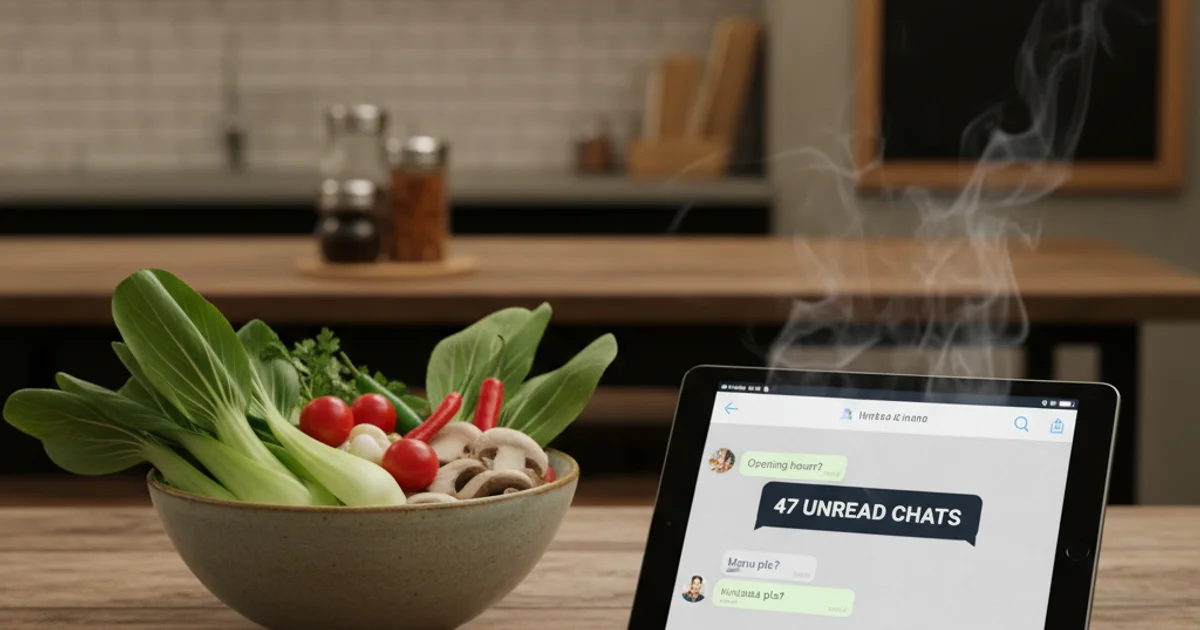
Last Tuesday, a restaurant owner showed me his WhatsApp. 47 unread messages from customers asking about opening hours, menu items, and whether he had their usual order ready. He was answering them one by one, between serving customers and prepping ingredients.
That's when I realized most restaurant owners in Singapore are sitting on their biggest marketing opportunity without knowing it. WhatsApp isn't just messaging. It's the most direct line to your customers' pockets. And unlike Instagram posts or Facebook ads, WhatsApp messages get read.
Why WhatsApp marketing works for Singapore restaurants
WhatsApp marketing reaches customers directly through automated messages triggered by their behavior — milestone rewards, birthday offers, win-back campaigns for inactive diners, and broadcast promotions to your entire customer base.
Singapore has widespread WhatsApp adoption across all demographics. Nearly every smartphone user has it installed. More importantly, people actually open WhatsApp messages. While email marketing typically sees lower engagement, WhatsApp messages consistently achieve high open rates within the first hour.
For restaurants, this matters because your customers aren't checking email for dinner plans. They're checking WhatsApp.
The psychology is simple: WhatsApp feels personal. When your restaurant sends a message saying "You're one stamp away from your free laksa," it doesn't feel like marketing. It feels like a friend reminding you about something good.
But here's what most restaurant owners get wrong: they think WhatsApp marketing means manually typing messages to customers all day. That's not marketing. That's customer service. Real WhatsApp marketing runs on autopilot.
The five types of WhatsApp messages that drive restaurant revenue
Singapore has one of the highest WhatsApp penetration rates in the world — 87% of Singaporeans use WhatsApp, and the average user spends 2 hours 17 minutes on social platforms daily (Hashmeta).
WhatsApp restaurant marketing works through five message types, each triggered automatically based on customer behavior rather than manual sending.
Milestone messages fire when customers hit stamp card milestones. "Congratulations! You've earned a free appetizer. Show this message to redeem." The timing is perfect — they just visited, they're already engaged with your brand, and you're rewarding loyalty.
Birthday messages turn birthdays into restaurant visits. "Happy birthday from [Restaurant Name]! Celebrate with us — here's 20% off your birthday meal." These work because birthdays are planned occasions. People are already thinking about where to celebrate.
Win-back messages target customers who haven't visited in 2-4 weeks. "We miss you at [Restaurant Name]. Here's $5 off your next visit to welcome you back." The key is the timing — not too early (they might just be busy) but not too late (they might have found somewhere else).
Welcome messages greet new loyalty members immediately after signup. "Welcome to [Restaurant Name]! You're already on your way to your first reward. See you soon." This sets expectations and reminds them why they joined.
Broadcast campaigns let you push time-sensitive offers to your entire customer base. "Rainy day special: 50% off hot soup until 6pm today." These work for clearing inventory, boosting slow periods, or capitalizing on events.
The automation is crucial. Manual WhatsApp marketing doesn't scale past 50 customers. Automated WhatsApp marketing works with 5,000.
Setting up WhatsApp automation for your restaurant
WhatsApp Business messages achieve a 98% open rate, vastly exceeding email's typical 20% — which is why restaurants serious about retention are moving critical reminders to WhatsApp.
WhatsApp Business API automation requires three components: a verified WhatsApp Business account, approved message templates, and trigger-based sending infrastructure.
First, you need WhatsApp Business API access, not the regular WhatsApp Business app. The app only allows manual messaging. The API allows automated campaigns. Getting API access typically requires a WhatsApp Business Solution Provider (BSP) like STAMPEDE, which handles the technical integration and template approval process.
Message templates must be pre-approved by WhatsApp. You can't send promotional messages with random text. Templates include placeholders for personalization — customer name, reward details, restaurant name — but the core structure stays fixed. Common restaurant templates include milestone rewards, birthday offers, inactive customer win-back, and promotional broadcasts.
The trigger system connects customer behavior to message sending. When a customer hits their 5th stamp, the system automatically sends the milestone template with their specific reward details. When someone hasn't visited in 21 days, they get the win-back template. When it's their birthday, they get the birthday template.
This infrastructure eliminates the manual work. You set up the templates once, define the triggers once, and the system runs continuously. New customers automatically enter the sequence. Existing customers move through it based on their behavior.
WhatsApp message templates that work for Singapore restaurants
The Singapore Food Agency tracked 23,589 licensed food shops and 14,134 food stalls in 2024 — the largest concentration of F&B outlets per capita in the region, and a reminder that discovery is a real problem for any single brand.
Effective WhatsApp templates for restaurants balance promotional value with genuine customer service, using Singapore-appropriate language and cultural references.
Milestone reward template:
"🎉 Congratulations {{customer_name}}! You've reached {{milestone_count}} stamps at {{restaurant_name}}. You've earned: {{reward_description}}. Show this message when you visit to redeem. Valid until {{expiry_date}}."
This template works because it's immediate gratification. The customer just completed an action (getting stamped) and immediately receives a reward. The redemption process is simple — show the phone screen.
Birthday offer template:
"🎂 Happy Birthday {{customer_name}}! Celebrate with us at {{restaurant_name}}. Enjoy {{birthday_offer}} on your special day. Valid for 7 days. See you soon!"
Birthday templates perform well because they're personal and tied to a celebration. The 7-day validity window accounts for busy schedules while creating urgency.
Inactive customer win-back template:
"We miss you at {{restaurant_name}}, {{customer_name}}! It's been a while since your last visit. Here's {{comeback_offer}} to welcome you back. Valid for the next 2 weeks."
Win-back messages work when they acknowledge the absence without being pushy. The tone should be warm, not desperate.
Broadcast promotion template:
"🌧️ Rainy day comfort at {{restaurant_name}}! All hot soups 30% off until 8pm today. Perfect weather for {{signature_dish}}. See you soon!"
Weather-triggered broadcasts perform exceptionally well in Singapore. Rainy day soup specials, hot weather cold drink promotions, and weekend family meal deals all tap into immediate customer needs.
The key to template success is personalization beyond just the customer name. Reference their specific milestone, their usual order category, or the weather outside. Generic feels like spam. Specific feels like service.
Measuring WhatsApp marketing performance for restaurants
WhatsApp marketing measurement focuses on four key metrics: delivery rate, open rate, click-through rate, and conversion rate to actual restaurant visits.
Delivery rate should consistently hit 95%+ for valid phone numbers. Lower delivery rates indicate number quality issues — customers providing fake numbers or numbers that are no longer active. Clean your database regularly and use double opt-in for new signups.
Open rates for WhatsApp typically exceed 90% within 24 hours. This is dramatically higher than email or SMS. If your open rates are below 85%, check your sending times and message frequency. Over-messaging kills engagement.
Click-through rates vary by message type. Milestone rewards see 60-80% click-through rates because customers want to claim their reward. Birthday offers typically see 30-50%. Broadcast promotions range from 15-35% depending on the offer strength and timing.
Conversion to visits is the metric that matters most for restaurants. This requires tracking which customers who received WhatsApp messages actually visited your restaurant afterward. Digital loyalty systems make this possible by connecting WhatsApp sends to stamp scans or coupon redemptions.
Track cost per visit alongside these engagement metrics. WhatsApp messages cost approximately $0.05-0.10 each to send. If a broadcast to 1,000 customers costs $75 and drives 150 visits, your cost per visit is $0.50. Compare this to Facebook ads or Google Ads which typically cost significantly more per restaurant visit.
Compliance and best practices for restaurant WhatsApp marketing
WhatsApp marketing in Singapore must comply with PDPA regulations and WhatsApp's own messaging policies to avoid account suspension and legal issues.
Opt-in requirements under PDPA mandate explicit consent before sending promotional messages. "By joining our loyalty program, you agree to receive promotional offers via WhatsApp" is sufficient. Customers must actively agree — pre-checked boxes don't count. Store consent records with timestamps for audit purposes.
Opt-out mechanisms must be clearly provided in every promotional message. Include "Reply STOP to opt out" in your templates. Process opt-outs within 24 hours and maintain a suppression list. Sending to opted-out numbers violates both PDPA and WhatsApp policies.
Message frequency limits prevent spam complaints. Limit promotional broadcasts to 2-3 times per week maximum. Behavioral triggers (milestones, birthdays) don't count toward this limit because they're service messages, not promotions. Test different frequencies with small customer segments before scaling.
Template approval process through WhatsApp requires templates to provide genuine value to customers. Purely promotional templates get rejected. Frame offers as customer benefits: "Celebrate your loyalty milestone" rather than "Buy more food." Include clear opt-out language and avoid aggressive sales language.
Business verification strengthens deliverability and customer trust. Verify your WhatsApp Business account with official business documents. Use your restaurant's actual business name, not a marketing alias. Upload a clear logo and business description.
Content guidelines prohibit certain types of restaurant marketing. No alcohol promotions (Singapore regulations), no misleading pricing, no urgent language designed to pressure customers. Keep messages conversational and helpful.
Monitor your account health through WhatsApp Business Manager. High spam complaint rates or policy violations can result in account suspension, cutting off your entire customer communication channel.
Integrating WhatsApp with your restaurant's growth engine
WhatsApp marketing delivers maximum impact when connected to your restaurant's broader customer retention and acquisition strategy, creating a growth loop that compounds over time.
The growth loop starts with retention through digital loyalty programs. Customers scan QR codes to earn stamps toward rewards. This creates a database of engaged customers with verified phone numbers who have already shown interest in returning.
Growth happens through referral programs triggered via WhatsApp. When customers hit milestones, they receive reward messages that include referral incentives: "Share your love for [Restaurant Name] — give friends $5 off their first visit and earn $5 credit when they visit." WhatsApp's native sharing makes this frictionless.
Engagement deepens through automated WhatsApp sequences that keep your restaurant top-of-mind between visits. Birthday offers, seasonal promotions, new menu announcements, and win-back campaigns maintain connection without manual effort.
This integration creates compound growth. Better retention builds a larger WhatsApp audience. Larger audience makes referrals more powerful. More referrals bring new customers who enter the loyalty program. The loop accelerates.
Most restaurant owners treat WhatsApp as a separate marketing channel. Smart restaurant owners treat it as the communication layer that connects everything else. Your POS handles transactions. WhatsApp handles relationships.
Advanced WhatsApp strategies for multi-outlet restaurants
Multi-outlet restaurant chains can leverage WhatsApp marketing across locations while maintaining personalized, local relevance for each branch.
Branch-specific messaging allows customers to receive offers relevant to their preferred location. A customer who always visits your Orchard outlet shouldn't get promotions for your Jurong branch. Segment your WhatsApp audience by most-visited location and send location-specific broadcasts.
Cross-location referrals expand your customer base efficiently. When customers refer friends, the system can recommend the nearest outlet to the friend's location. This prevents referral drop-off due to inconvenient locations while expanding your geographic reach.
Outlet performance tracking through WhatsApp metrics reveals which locations have the most engaged customer bases. Track message open rates, click-through rates, and redemption rates by outlet. Use this data to identify training opportunities or operational issues affecting customer experience.
Centralized template management with local customization maintains brand consistency while allowing outlet-specific offers. Corporate creates the template framework. Individual outlets customize details like operating hours, local menu specials, or nearby landmark references.
Staff coordination ensures WhatsApp promises align with outlet execution. When a customer receives a WhatsApp coupon, all staff at all locations should know how to redeem it. Use your point-of-sale system's notes feature or staff WhatsApp groups to communicate active promotions.
The goal is making WhatsApp feel personal to each customer while maintaining operational efficiency across multiple locations. Customers should feel like they're messaging their neighborhood restaurant, not a corporate chain.
Common WhatsApp marketing mistakes Singapore restaurants make
Restaurant owners frequently sabotage their WhatsApp marketing effectiveness through predictable mistakes that damage customer relationships and waste marketing budget.
Over-messaging is the fastest way to generate opt-outs. Sending daily promotional messages feels desperate and spammy. Customers joined your loyalty program for rewards, not constant sales pitches. Limit promotional broadcasts to 2-3 times per week maximum. Let behavioral triggers (milestones, birthdays) handle the rest.
Generic messaging wastes WhatsApp's personalization advantage. "Dear customer" messages perform poorly compared to "Hi Sarah" messages. Use customer names, reference their favorite dishes, acknowledge their loyalty level. Generic feels like mass marketing. Personal feels like customer service.
Poor timing kills message effectiveness. Sending breakfast promotions at 9pm or dinner specials at 6am trains customers to ignore your messages. Analyze when your customers typically visit and time messages accordingly. Lunch promotions work best between 10am-12pm. Dinner promotions perform well between 3pm-5pm.
Weak offers generate low engagement and poor redemption rates. "10% off your next visit" doesn't motivate action in Singapore's competitive F&B market. Make offers compelling: "Buy one main dish, get one free" or "Free dessert with any entrée." The offer should feel like genuine value, not a token discount.
No clear call-to-action confuses customers about next steps. "Thanks for being a loyal customer" without redemption instructions wastes the message. Every promotional WhatsApp should include specific action steps: "Show this message to your server" or "Mention this offer when ordering."
Ignoring opt-outs violates PDPA regulations and damages your sender reputation. Process opt-out requests within 24 hours. Continuing to message opted-out customers can result in spam complaints that suspend your WhatsApp Business account.
Manual management prevents scaling beyond small customer bases. Typing individual WhatsApp messages doesn't scale past 50-100 customers. Invest in automation tools that handle template sending, trigger management, and opt-out processing automatically.
The biggest mistake is treating WhatsApp like a broadcast channel instead of a relationship channel. Successful restaurant WhatsApp marketing feels like helpful communication, not aggressive promotion.
Getting started with WhatsApp marketing for your restaurant
Implementing WhatsApp marketing requires four foundational steps: customer database building, WhatsApp Business API setup, template creation, and automation configuration.
Start with customer data collection through a digital loyalty program. You need phone numbers and customer behavior data to make WhatsApp marketing effective. QR code-based loyalty cards work well in Singapore — customers scan to earn stamps, providing their phone number in the process. This creates your WhatsApp audience organically.
Set up WhatsApp Business API through a certified Business Solution Provider. The regular WhatsApp Business app only allows manual messaging. API access enables automation, template management, and integration with your customer database. The setup process typically takes 1-2 weeks for approval.
Create your message templates based on your restaurant's customer journey. Start with essential templates: milestone rewards, birthday offers, and welcome messages. Get these approved by WhatsApp before launching. Add broadcast promotion templates and win-back campaigns once your core automation is working.
Configure automation triggers that connect customer behavior to message sending. When customers hit loyalty milestones, they should automatically receive reward messages. When it's their birthday, they should get birthday offers. When they haven't visited in 21 days, they should receive win-back messages.
Test with a small group before rolling out to your entire customer base. Send test messages to staff and regular customers. Check message formatting, redemption processes, and opt-out functionality. Fix any issues before scaling to hundreds or thousands of customers.
Monitor and optimize based on performance data. Track delivery rates, open rates, and redemption rates by message type. Adjust timing, offers, and frequency based on what drives the most restaurant visits. WhatsApp marketing improves with iteration and testing.
The key is starting simple and building complexity over time. Master basic milestone rewards before adding sophisticated broadcast campaigns. Get comfortable with automation before attempting advanced segmentation.
If you run a restaurant in Singapore and want to try automated WhatsApp marketing, STAMPEDE includes pre-approved templates and trigger-based automation. No technical setup required — just connect your customer database and start sending.