Last week, a hawker stall owner showed me his Meta ads dashboard. $800 spent over two months. 47 clicks. Zero visits he could track.
"I tried everything," he said. "Boosted posts about our signature laksa. Targeted food lovers in Singapore. Even tried that lookalike audience thing. Nothing."
His mistake wasn't the creative or the budget. It was treating Facebook ads like a billboard instead of a conversation starter with three very different types of people.
The three-audience framework for restaurant ads
Restaurant advertising fails when you try to speak to everyone at once. Your regular customer, the person who's never heard of you, and the customer who visited once but hasn't returned — they need completely different messages at different stages.
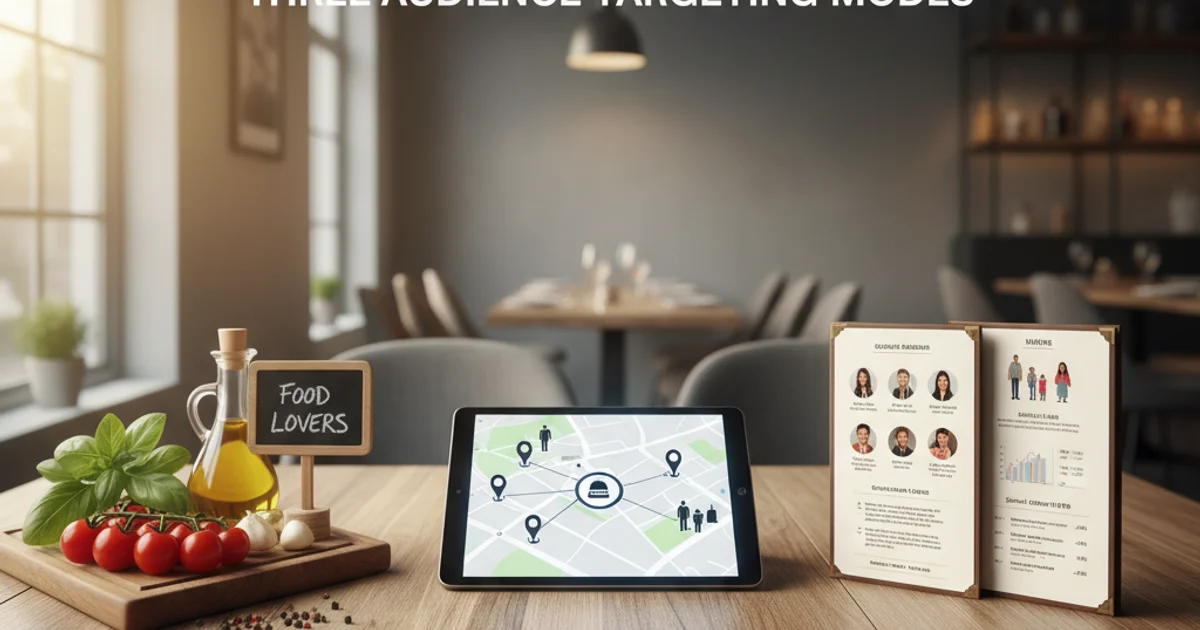
Mode 1: Geolocation targeting captures people already in your area who are ready to eat now. Mode 2: Lookalike audiences finds people similar to your best customers across Singapore. Mode 3: Retargeting brings back people who showed interest but haven't visited yet.
Each mode serves a different part of your growth engine: retain existing customers, grow through new discovery, and engage warm prospects who need a nudge.
Most restaurant owners pick one and wonder why it doesn't work. The magic happens when you run all three simultaneously with different creative and different goals.
Mode 1: Geolocation targeting — capturing foot traffic
Geolocation targeting shows your ads to people within a specific radius of your restaurant. Not people who live nearby. People who are physically there right now.
This is immediate-intent advertising. Someone is in Chinatown at 7 PM on a Wednesday. They're hungry. They're looking around. Your ad appears: "Handmade xiao long bao 2 minutes away."
How it works: Set a 500-meter radius around your restaurant. Target people currently in that location during your operating hours. Use creative that emphasizes proximity and immediate availability.
The conversion window is tight — maybe 30 minutes. But the intent is high. One restaurant we work with sees significantly higher visit rates from geolocation ads compared to broad Singapore targeting.
Creative strategy: Skip the brand story. Lead with the food and the distance. "Fresh char kway teao, 50 meters from Raffles Place MRT" works better than "Traditional recipes passed down three generations."
Include your address in the ad copy. People in geolocation campaigns are already nearby — they want to know exactly where you are, not why your laksa is special.
Mode 2: Lookalike audiences — scaling beyond your neighborhood
Lookalike audiences find people across Singapore who behave like your best customers. Facebook analyzes your customer list and finds people with similar demographics, interests, and online behaviors.
This is discovery advertising. You're introducing your restaurant to people who don't know you exist but have a high probability of becoming regulars.
The data foundation: Lookalike audiences are only as good as the seed audience you provide. Upload your loyalty program members, not everyone who ever visited once. Quality over quantity.
One bubble tea chain uploaded their loyalty members to create a 1% lookalike audience — the top 1% of Singapore's population most similar to their regulars. The result: significantly lower cost per visit compared to broad interest targeting.
Creative strategy: Focus on what makes you different, not just what you serve. "Singapore's only Korean ginseng chicken soup at a hawker stall" tells a story. "Delicious chicken soup" doesn't.
Include social proof. "500+ regulars can't be wrong" or "Featured in The Straits Times" gives context to people discovering you for the first time.
The conversion window is longer — maybe 2-3 weeks. Someone sees your ad in Jurong, remembers it, visits when they're in your area later. This is why tracking actual visits matters for restaurant ads.
Mode 3: Retargeting — converting warm prospects
Retargeting shows ads to people who visited your website, engaged with your social media, or signed up for your loyalty program but haven't been back recently.
This is nurture advertising. They know who you are. They've shown interest. They just need a reason to choose you tonight instead of the 12 other options nearby.
Website retargeting: Anyone who visited your menu page or location page in the past 30 days gets ads featuring your most popular dishes and current promotions.
Social media retargeting: People who liked, shared, or commented on your posts get ads with exclusive offers. "Thanks for following us — here's 20% off your next visit."
Loyalty retargeting: Members who haven't visited in 14+ days see ads featuring their favorite dishes or milestone rewards. "Your 8th stamp is waiting — one more for a free drink."
One restaurant runs retargeting ads to loyalty members who haven't visited in two weeks. The ad shows their progress toward their next reward: "You're 2 stamps away from free banchan." Strong visit rates follow.
Creative strategy: Personalization wins. Use dynamic product ads to show the specific dishes they've ordered before. Reference their loyalty status. Make it feel like a personal invitation, not a generic promotion.
How the three modes work together
The power isn't in picking one mode. It's in running all three as part of a complete growth system.
Week 1: New customer discovers you through a lookalike audience ad. Visits. Signs up for your loyalty program at checkout.
Week 2: They're in your area again. See a geolocation ad. Remember your restaurant. Visit again. Get their second stamp.
Week 3: They haven't been back. Retargeting ad shows their progress: "3 stamps collected, 5 more for a free meal." They visit twice that week.
This is the retain → grow → engage flywheel in action. Lookalike audiences grow your customer base. Geolocation ads retain customers when they're nearby. Retargeting engages warm prospects and brings back lapsed customers.
Each mode feeds the others. Geolocation ads work better when people already know your brand from lookalike campaigns. Retargeting works better when you have loyalty data to personalize with. Lookalike audiences improve as you add more quality customers to your seed list.
Attribution and measurement that actually works
Most restaurant owners can't tell which ads drive visits because they can't track offline conversions. Someone sees your ad on Monday, visits on Thursday, pays cash. How do you connect the dots?
STAMPEDE's Magic Ads tracks this through physical proof-of-visit actions. Customer sees your Meta ad, clicks through to sign up for your loyalty program. When they visit and scan their QR code for a stamp, that visit gets attributed back to the original ad campaign within a 21-day window.
The metric that matters: cost per visit, not cost per click. Total ad spend divided by the number of stamp scans from ad-attributed customers.
This attribution works through action-based tracking, not location surveillance. Customers actively present their QR code to get stamped — that's the proof of visit. No GPS tracking or geofencing required.
Setting up your three-mode campaign
Start with geolocation targeting. It's the easiest to set up and delivers the fastest results. 500-meter radius during operating hours. Creative focused on proximity and immediate availability.
Add lookalike audiences once you have 100+ loyalty members. Upload your member list to Facebook. Create a 1% lookalike audience. Test 1%, 2%, and 3% to find your sweet spot between reach and relevance.
Layer in retargeting after 30 days. You need time to build audiences of website visitors, social media engagers, and loyalty members. Start with loyalty member retargeting — highest intent, best conversion rates.
Run each mode as a separate campaign with separate budgets. Geolocation gets 40% of your ad budget (immediate results), lookalike gets 40% (long-term growth), retargeting gets 20% (high-conversion nurture).
Monitor cost per visit, not just cost per click. Optimize for visits, not engagement. A restaurant ad that gets 1,000 likes but zero visits is a waste of money.
Common mistakes that kill restaurant ad performance
Mistake 1: Targeting "food lovers in Singapore." Too broad. Singapore has 5.9 million residents who eat food. Your laksa isn't for all of them.
Mistake 2: Running only lookalike audiences. You're ignoring people already in your area who are ready to eat now.
Mistake 3: Boosting posts instead of running conversion campaigns. Post engagement doesn't pay rent. Visits do.
Mistake 4: Using the same creative for all three modes. Someone discovering you for the first time needs different messaging than someone who visited last week.
Mistake 5: No attribution tracking. You can't optimize what you can't measure. Without offline attribution, you're flying blind.
The hawker stall owner? He switched to this three-mode approach. Month one: tracked visits increased significantly. Month two: even better results. Month three: consistent growth. Same budget. Better targeting.