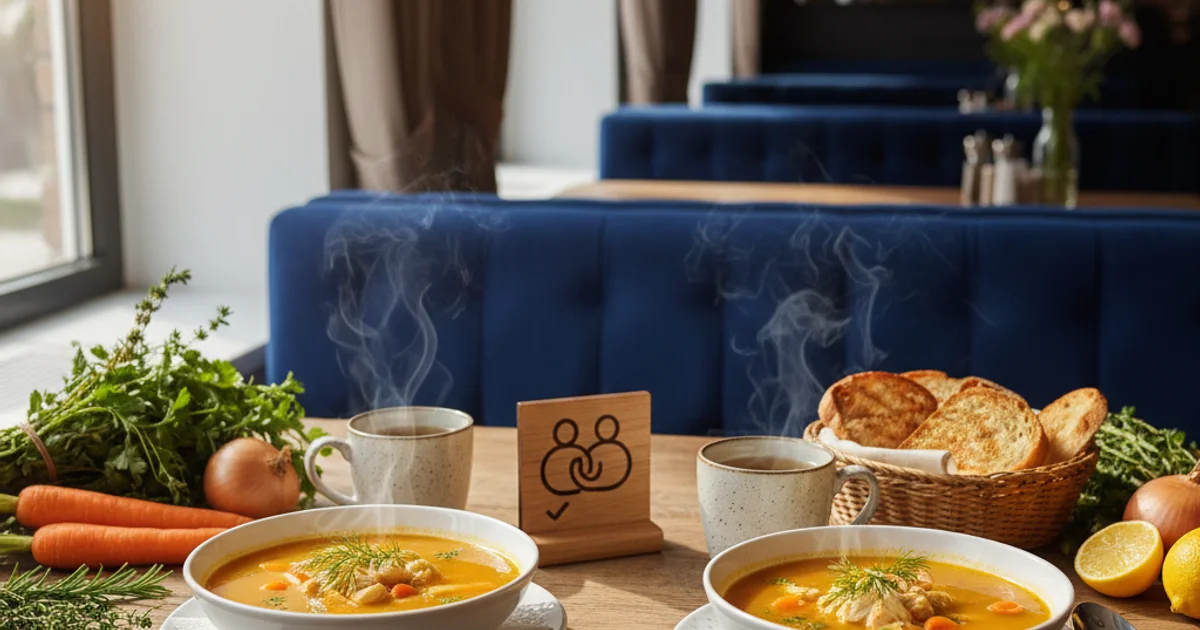
Last month, a chicken soup restaurant added one line to their checkout process: "Bring a friend next week and you both get free soup."
Within 30 days, 23% of their new customers came through referrals. No ads. No influencers. Just customers bringing friends.
Most restaurant owners think referral programs are complicated loyalty schemes that require apps and point systems. They're not. The best referral programs are simple trades: you bring someone, you both get something. The trick is structuring the reward so both people feel like they're winning.
Why most restaurant referral programs fail
Restaurant referral programs fail because they're designed like corporate loyalty schemes instead of neighborhood word-of-mouth.
The typical mistake: "Refer 5 friends and get a $20 voucher." This puts all the value on the referrer and makes the program feel like work. The friend gets nothing special for being referred, so they have no reason to care about the program.
The second mistake: complicated tracking. QR codes that don't work, apps that crash, point systems nobody understands. If your cashier can't explain how it works in one sentence, it's too complicated.
The third mistake: rewards that don't match your customer behavior. A fine dining restaurant offering "buy 10, get 1 free" doesn't understand that their customers come twice a year, not twice a week.
The two-sided reward principle
The best restaurant referral programs reward both people: the customer who refers and the friend who gets referred.
This creates a psychological win-win. The referrer feels good about giving their friend a deal. The friend feels special for getting insider access. Both people associate positive feelings with your restaurant.
Two-sided rewards also solve the tracking problem. Both people need to show up and claim their rewards, which gives you two data points instead of one. You can measure both referral generation (how many people your customers bring) and referral conversion (how many referred friends become repeat customers).
10 reward structures that work
1. The Welcome Pair
Both referrer and friend get the same reward when the friend makes their first visit.
Example: "Bring a friend who's never been here. You both get a free appetizer."
Works best for: Casual dining, cafes, fast-casual restaurants where the average ticket is $15-30.
Why it works: Equal rewards feel fair. The friend doesn't feel like they're being used to unlock someone else's discount.
2. The Upgrade Trade
The referrer gets an upgrade to their current order. The friend gets a starter reward.
Example: "Bring a friend today. Upgrade your regular coffee to any specialty drink free. Your friend gets 20% off their first order."
Works best for: Coffee shops, bubble tea, quick service restaurants with clear upgrade paths.
Why it works: The referrer gets immediate gratification. The friend gets a reason to try something they might not normally order.
3. The Milestone Multiplier
Referral rewards increase based on how many people someone has referred.
Example: "First friend you bring: you both get free dessert. Third friend: you both get free mains. Fifth friend: you both get the chef's tasting menu."
Works best for: Restaurants with diverse menu price points, places that want to identify their biggest advocates.
Why it works: Gamifies the referral process. Your best customers become active promoters chasing higher rewards.
4. The Group Bonus
Rewards scale with group size when multiple people come together.
Example: "Bring 2 friends: everyone gets 10% off. Bring 4 friends: everyone gets 20% off. Table of 6+: everyone eats free dessert."
Works best for: Family restaurants, celebration venues, places with large tables and group-friendly menus.
Why it works: Encourages larger gatherings, which typically have higher ticket sizes and create more social proof.
5. The Time-Sensitive Double
Higher rewards for referrals that happen within a specific timeframe.
Example: "Bring a friend within 7 days of your last visit. You both get a free drink. After 7 days: you both get 15% off."
Works best for: High-frequency businesses like bubble tea, coffee shops, casual lunch spots.
Why it works: Creates urgency and keeps your restaurant top-of-mind when customers are deciding where to eat with friends.
6. The Experience Unlock
Referrals unlock special menu items, seating areas, or experiences not available to regular customers.
Example: "Bring a friend and unlock our secret menu. Both of you can order any off-menu item the chef recommends."
Works best for: Unique concept restaurants, chef-driven places, establishments with strong culinary identity.
Why it works: Makes customers feel like insiders. The reward is an experience, not just a discount.
7. The Seasonal Celebration
Referral rewards tied to holidays, seasons, or local events.
Example: "Bring a friend during Chinese New Year week. You both get our prosperity set menu at 50% off."
Works best for: Restaurants with seasonal menus, cultural cuisine, places that celebrate local festivals.
Why it works: Creates natural conversation starters and gives customers a reason to share during high-social periods.
8. The Loyalty Crossover
Referral rewards that enhance your existing loyalty program.
Example: "Bring a friend. You both get 2 stamps instead of 1 on today's visit. Your friend also starts with 1 bonus stamp."
Works best for: Restaurants that already have digital stamp cards or point-based loyalty systems.
Why it works: Accelerates loyalty program engagement and gives new customers a head start on rewards.
9. The Category Champion
Different rewards based on what type of friend is referred (first-timer, returning customer, competitor's customer).
Example: "Bring someone who's never tried Korean food: you both get the beginner's combo. Bring someone from another Korean restaurant: you both get the chef's special."
Works best for: Ethnic cuisine, specialized food categories, restaurants competing directly with nearby similar establishments.
Why it works: Acknowledges different referral scenarios and rewards customers for expanding your market reach.
10. The Reverse Referral
The friend who was referred becomes the referrer for their next visit, creating a chain effect.
Example: "When someone brings you here, you get 25% off today. Bring someone else within 30 days, and you both get 25% off again."
Works best for: Restaurants with strong social media presence, unique concepts that naturally generate word-of-mouth.
Why it works: Creates a viral loop where each referred customer becomes a potential referrer, multiplying your reach.
How to choose your reward structure
Your reward structure should match three things: your average ticket size, your customer frequency, and your profit margins.
High-frequency, low-ticket businesses (bubble tea, coffee, fast-casual) work best with upgrade trades and time-sensitive doubles. Customers come often enough to refer multiple people, and small upgrades don't hurt margins.
Low-frequency, high-ticket businesses (fine dining, celebration restaurants) work better with experience unlocks and group bonuses. Customers don't come often, so the reward needs to be memorable and justify a special trip.
Mid-range restaurants with regular but not daily customers (casual dining, neighborhood spots) get the most flexibility. Welcome pairs and loyalty crossovers work well because they balance immediate gratification with long-term program engagement.
The key metric isn't how much you spend on rewards. It's how much new business each referral generates. Singapore's restaurant industry has grown consistently, driven largely by businesses that focused on customer acquisition rather than just operational efficiency.
The growth loop connection
Referral programs work best when they're part of a complete growth system, not standalone promotions.
The cycle works like this: customers visit and join your digital loyalty program → they earn stamps and rewards → automated WhatsApp messages remind them about referral opportunities → they bring friends → friends join the loyalty program → the loop repeats.
How to automate referral reminders and rewards through WhatsApp campaigns
Each component amplifies the others. Loyalty programs give you customer data to track referrals. WhatsApp automation reminds customers about referral opportunities at the right moments. Referral rewards bring in new customers who join the loyalty program.
Without this integration, referral programs become one-off promotions that fade after the initial excitement. With it, they become self-sustaining growth engines that compound over time.
Implementation tips
Start simple. Pick one reward structure and test it for 30 days before adding complexity.
Train your staff to mention the referral program naturally: "Bringing anyone special next time? They'd love our signature dish." Not: "Don't forget about our referral program terms and conditions."
Track both sides of the equation. How many customers refer friends (participation rate) and how many referred friends become repeat customers (conversion rate). A program with 10% participation and 80% conversion beats one with 30% participation and 20% conversion.
Make the mechanics invisible to customers. They should understand the reward instantly but never think about the tracking system behind it.
Research from Nielsen shows that most consumers trust referrals from people they know more than any other form of advertising, making referral programs one of the most effective marketing channels for local restaurants.