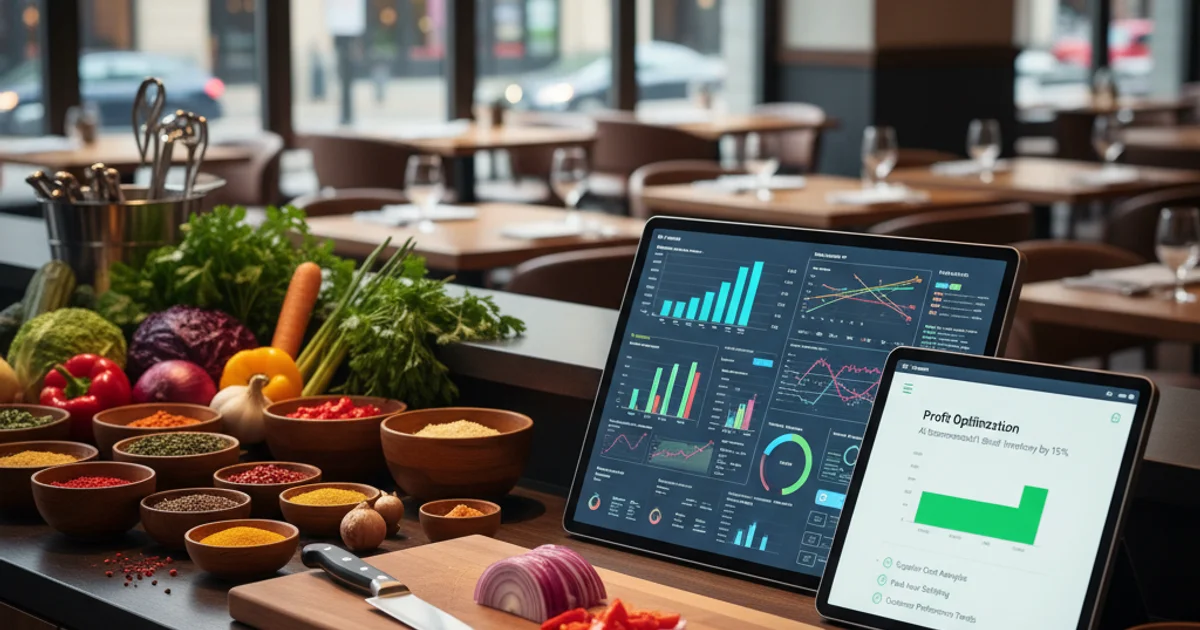
Last week, a restaurant owner showed me his POS dashboard. Seventeen different metrics. Revenue by hour, items sold, payment methods, staff performance. He scrolled through five screens of charts and graphs.
Then he asked: "So should I run a promotion this week or not?"
The dashboard had no answer.
That's the problem with most restaurant dashboards. They show you what happened. They don't tell you what to do next. And for a restaurant owner juggling staff schedules, supplier issues, and rent payments, "what happened" isn't enough. You need "what should I do about it."
Traditional restaurant dashboards: all data, no direction
Most restaurant dashboards follow the same playbook. Revenue charts, transaction counts, average order values, busiest hours. They assume that if you give an owner enough numbers, insights will magically appear.
But insights don't work that way. Raw data without context is just noise. A spike in weekend sales could mean your new menu item is working, or it could mean the restaurant next door closed for renovation. A drop in Tuesday lunch traffic could signal a problem with your service, or it could mean the office building across the street is working from home.
Traditional dashboards can't tell the difference. They show correlations, not causations. They highlight changes without explaining why those changes matter or what you should do about them.
The result? Restaurant owners spend time staring at charts instead of acting on opportunities.
The three problems with restaurant data
Problem 1: Context collapse
Your POS system excels at tracking transactions, inventory, and operational metrics. It doesn't know that 23 of yesterday's 47 drinks went to first-time customers who might never come back, while 24 went to regulars who visit twice a week. Context matters more than volume.
Problem 2: Backward-looking metrics
Revenue reports tell you what you made last month. Customer acquisition costs tell you what you spent last quarter. But restaurant success depends on forward-looking decisions: which customers to target, what promotions to run, when to adjust staffing levels.
Problem 3: Action paralysis
When everything is a metric, nothing is a priority. Restaurant dashboards present 20 different numbers with equal weight. Owners end up optimizing for whatever metric moved most recently, not whatever metric actually drives growth.
How AI reports work differently
AI reports don't just aggregate data. They analyze patterns, identify opportunities, and recommend specific actions. Instead of showing you 17 metrics, they answer three questions: What's working? What's not working? What should you do this week?
Here's what that looks like in practice.
Pattern recognition over raw numbers
An AI report might notice that customers who visit on weekdays have a 40% higher lifetime value than weekend customers, even though weekend revenue is higher. It connects this insight to a specific recommendation: run weekday-focused promotions to attract higher-value segments.
Predictive insights over historical data
Instead of telling you that Tuesday sales dropped 15% last month, an AI report predicts which specific customers are at risk of churning this week. It identifies regulars who haven't visited in 10+ days and suggests targeted WhatsApp messages to bring them back.
Actionable recommendations over charts
Rather than presenting a graph of redemption rates, an AI report says: "Your stamp completion rate shows room for improvement. Consider adding a mid-journey reward to increase customer progression." Specific problem, specific solution.
The intelligence layer difference
Traditional restaurant dashboards are reporting tools. AI reports are intelligence systems. The difference is architectural.
A reporting tool takes your transaction data and arranges it into charts. An intelligence system takes your customer behavior data and finds patterns humans miss. It tracks not just what people bought, but when they're likely to buy again, which promotions actually work, and how to optimize your growth loop.
For restaurants, this means shifting from operational metrics to growth metrics. Instead of tracking average order value, track customer lifetime value. Instead of measuring daily revenue, measure repeat visit rates. Instead of counting transactions, count relationships.
The growth loop for restaurants works like this: a customer visits, earns loyalty stamps, receives WhatsApp messages about rewards, redeems coupons, and refers friends. Each step generates data. AI reports analyze that entire loop and tell you which step needs attention.
What AI reports actually tell restaurant owners
Customer retention insights
"Your customers tend to slow down after earning several stamps. Consider adding a bonus reward at the midpoint to bridge this gap." This is actionable. You know exactly what to fix and how to fix it.
Revenue optimization opportunities
"Customers who join your loyalty program on weekdays spend more per visit than weekend joiners. Run a Tuesday lunch promotion to attract more weekday signups." Specific segment, specific action.
Marketing performance analysis
"Your WhatsApp birthday messages have strong redemption rates, but your 'haven't seen you' messages underperform. Adjust your inactive customer messaging to focus on specific menu items instead of generic offers." Clear feedback loop.
Referral program effectiveness
"Your referral program shows good conversion rates. The highest-performing referrers are customers with multiple stamps. Target your referral campaigns to this segment for better results." Data-driven targeting.
According to Singapore's Department of Statistics, the F&B sector accounts for 1.8% of Singapore's GDP, making customer retention insights crucial for the approximately 13,400 licensed food establishments across the island.
The weekly cadence advantage
Most restaurant dashboards are either real-time (overwhelming) or monthly (too late). AI reports work on a weekly cadence. Long enough to identify meaningful patterns, short enough to act on opportunities before they disappear.
A weekly AI report might identify that your lunch crowd is shifting from office workers to retirees, suggest adjusting your menu pricing accordingly, and recommend WhatsApp campaigns to target the new demographic. By the time a monthly dashboard shows this trend, you've missed four weeks of optimization.
The weekly format also matches how restaurants actually operate. Menu changes happen weekly. Staff schedules are planned weekly. Promotion cycles run weekly. AI reports align with your decision-making rhythm instead of fighting against it.
From reactive to predictive restaurant management
The biggest difference between dashboards and AI reports is temporal. Dashboards are reactive—they tell you what already happened. AI reports are predictive—they tell you what's likely to happen and how to influence it.
A reactive approach: "Sales dropped 20% last week. What went wrong?"
A predictive approach: "Based on current customer behavior patterns, sales will likely drop 15% next week unless you run a targeted campaign to your at-risk segment."
For restaurant owners, this shift from reactive to predictive management changes everything. Instead of constantly putting out fires, you prevent them. Instead of wondering why revenue fluctuates, you understand the patterns driving those fluctuations.
The result is better decision-making with less stress. You're not guessing whether to run a promotion or adjust your menu. The AI tells you which customers need attention, which campaigns will work, and when to take action.
How POS and AI reports work together
Your POS system handles what it does best: processing orders, tracking inventory, managing staff schedules, and recording transactions. STAMPEDE's AI reports handle what POS systems can't: analyzing customer relationships, predicting behavior patterns, and recommending growth strategies.
They work side by side, not wired together. Your POS manages operations. AI reports drive growth. When a customer visits, your POS processes their order while they scan a QR code to earn loyalty stamps. That stamp data feeds the AI analysis, but the systems remain independent.
This separation is actually a strength. Switch POS providers tomorrow and your customer relationship data stays intact in STAMPEDE. Your loyalty program, referral system, and AI insights continue uninterrupted because they don't depend on any specific operational system.