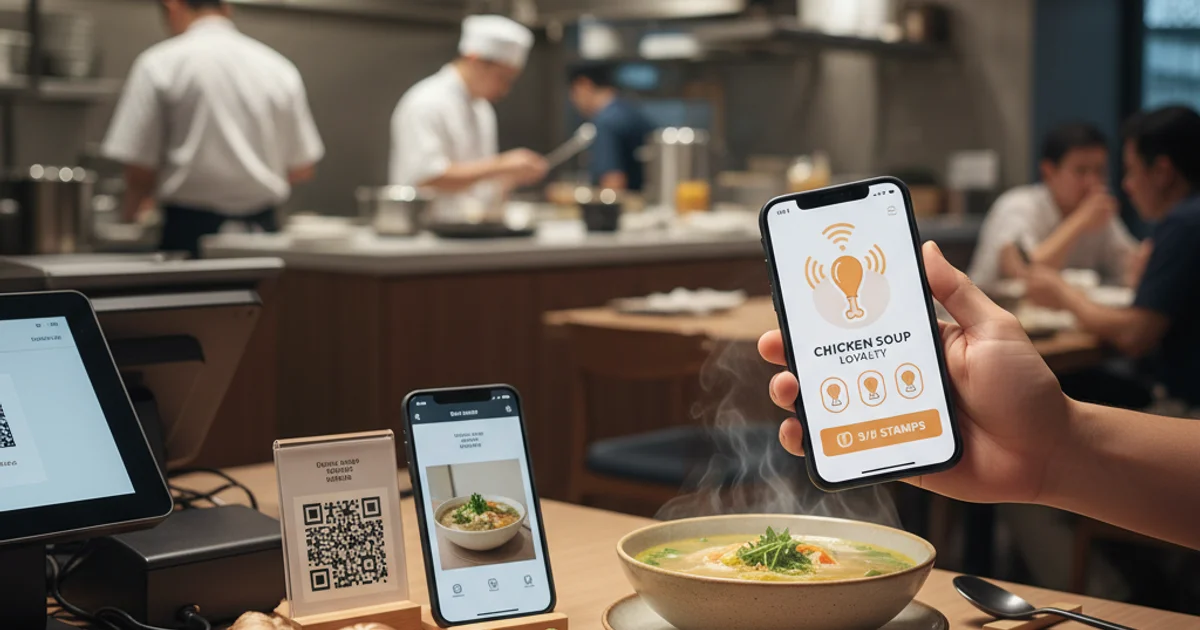
Last Tuesday, I watched a customer at a chicken soup restaurant in Bedok tap their phone on a small sticker next to the cashier. One second later, their loyalty card updated with three stamps. No scanning. No camera permission. No "hold still while I focus."
Then I watched the next customer pull out their phone, open the camera, and scan a QR code. Same result. Three stamps added. Different experience.
Both methods get stamps onto digital loyalty cards. But after testing both at multiple restaurant locations across Singapore, one consistently performs better than the other. Here's what we learned.
How NFC tap-to-stamp actually works
NFC tap-to-stamp uses Near Field Communication technology built into most smartphones. Restaurant owners place a small NFC sticker or tag at the counter. Customers tap their phone on the tag, and their loyalty card opens automatically with stamps already selected.
The customer sees their current progress, selects how many stamps to add (usually 1-3 based on order size), and confirms. The stamp appears on their digital card in real time. No camera required. No app download needed.
NFC tags cost about $0.80 each on Shopee. They're programmable once and work indefinitely. The restaurant can set different stamp amounts per tag: one stamp for drinks, two for mains, three for family sets.
For customers, it feels like magic. Phone touches sticker. Loyalty card appears. Stamps added. Done in under five seconds.
The QR code scanning experience
Singapore's F&B sector is brutally competitive — over 13,000 F&B establishments compete for attention in a city-state of just 5.7 million residents, which is why retention economics matter more here than almost anywhere else.
QR code scanning requires customers to open their phone camera and point it at a printed code. The camera focuses, reads the code, and opens the loyalty page in their browser. From there, they select stamp amounts and confirm.
QR codes are free to generate and print. They work on any phone with a camera, including older models without NFC capability. The codes can be printed on receipt paper, laminated cards, or stuck to the counter.
Most Singapore customers are familiar with QR codes from SafeEntry during COVID-19 and payment apps like PayNow. There's no learning curve.
The scanning process takes 3-8 seconds depending on lighting conditions and camera quality. Older phones or dim lighting can extend this to 10+ seconds.
Speed comparison in real restaurant conditions
Singapore has 97% smartphone penetration (Statista), one of the highest rates globally — which is exactly why a browser-based PWA loyalty program works here without forcing customers to download an app.
Speed matters in restaurants. Every second at checkout affects queue length, staff efficiency, and customer satisfaction.
NFC consistently wins on speed. Tap and done. No camera positioning. No focus hunting. No "try again" moments when the code won't scan.
QR codes add 2-5 seconds per interaction. This sounds minimal until you multiply it across 100+ daily transactions. During lunch rush at a hawker stall, those extra seconds compound into longer queues.
However, QR codes have one speed advantage: they work from a distance. Customers can scan while waiting in line, entering their details before reaching the counter. NFC requires physical proximity to the tag.
The fastest implementation combines both: QR code on table tents for pre-ordering customers, NFC tag at the counter for walk-ups.
Customer adoption rates
WhatsApp Business messages achieve a 98% open rate, vastly exceeding email's typical 20% — which is why restaurants serious about retention are moving critical reminders to WhatsApp.
NFC adoption varies by demographic. Younger customers (18-35) adapt immediately. They're used to contactless payments and understand the tap gesture. Older customers often need one demonstration before they get it.
QR codes have broader demographic appeal. Anyone who used SafeEntry can scan a QR code. The visual feedback of seeing the camera focus helps customers understand when it's working.
In testing across multiple restaurant types, both methods show strong adoption once customers understand them. QR codes benefit from immediate familiarity, while NFC creates a premium experience that customers remember.
The learning curve matters. QR codes are immediately intuitive. NFC requires explaining the tap gesture once, then it's faster forever.
Technical reliability factors
NFC works in any lighting condition. Bright sunlight, dim restaurant ambiance, or complete darkness don't affect performance. The tag either reads or doesn't. No gradual degradation.
QR codes struggle in poor lighting. Reflective surfaces, shadows, or worn prints can cause scanning failures. Laminated codes work better than paper prints, which fade or tear over time.
Phone compatibility favors QR codes. Every smartphone camera can scan QR codes. NFC requires phones made after 2012 and NFC enabled in settings. About 8-12% of customers have NFC-incompatible phones.
Water damage affects both differently. Wet NFC tags still work. Wet QR codes become unreadable until they dry.
Staff training requirements
QR codes require minimal staff training. Point customers to the code. Tell them to scan with their camera. Most customers figure it out independently.
NFC needs slightly more explanation. Staff must demonstrate the tap gesture and explain where to touch. Some customers try to hover their phone above the tag rather than making contact.
Both methods reduce staff workload compared to manual stamp card management. No physical cards to track. No stamps to apply. No lost card replacement. The digital system handles everything automatically.
The biggest training challenge isn't the technology. It's remembering to mention the loyalty program at checkout. This applies equally to both NFC and QR methods.
Cost and setup comparison
| Factor | NFC Tags | QR Codes |
|---|
| Initial cost | $0.80 per tag | Free to generate |
| Printing cost | None | $2-5 for laminated cards |
| Replacement frequency | Never (unless damaged) | 6-12 months (fading/wear) |
| Setup time | 2 minutes programming | 30 seconds printing |
| Ongoing maintenance | None | Reprint when worn |
Total cost over two years: NFC tags cost $0.80 once. QR codes cost $2-5 initially plus $2-10 in reprints. NFC becomes cheaper long-term despite higher upfront cost.
Setup complexity is similar. Both require programming the loyalty page URL and testing with staff phones before going live.
Integration with the restaurant growth loop
Both NFC and QR codes serve the same purpose in the retain → grow → engage flywheel. They capture customer data at the point of sale, creating the database that powers referral programs and WhatsApp automation.
The speed difference affects retention rates. Faster check-in means less friction, which means higher signup rates. Higher signup rates mean more customers in your database for WhatsApp automation campaigns and referral program launches.
Once customers are in the system, the check-in method becomes irrelevant. Whether they joined via NFC or QR, they receive the same milestone rewards, birthday coupons, and referral opportunities.
The real growth multiplier comes from what happens after the stamps are added. AI weekly reports analyze customer behavior patterns regardless of how they checked in, identifying which customers are at risk of churning and which are ready for referral campaigns.
Which method wins for different restaurant types
Hawker stalls and food courts: QR codes win. High customer turnover, diverse age groups, need for distance scanning while queuing. Cost sensitivity favors free QR generation over NFC tag purchase.
Casual dining restaurants: NFC tags win. Table service allows staff to demonstrate the tap gesture. Younger customer demographics. Premium positioning justifies the $0.80 tag cost.
Fast-casual chains: Hybrid approach works best. QR codes on table tents for dine-in customers, NFC tags at takeaway counters. Covers all use cases without choosing sides.
Bubble tea shops: NFC tags win. High-frequency customers (3-5 visits per week) benefit from the speed advantage. Young customer base adapts quickly to tap gesture.
Coffee shops: QR codes win. Morning rush requires maximum compatibility. Office workers scanning while walking to the counter. Older demographic mixed with younger.
The hybrid recommendation
After testing both methods across multiple restaurant types, the optimal setup isn't choosing one over the other. It's deploying both strategically.
Place QR codes where customers have time to scan: table tents, waiting areas, menu boards. Place NFC tags where speed matters: checkout counters, pickup windows, cashier stations.
This covers every customer preference and technical limitation. NFC-incompatible phones can use QR codes. Customers in bright sunlight can use NFC tags. Everyone gets the fastest available option.
The cost is minimal: one NFC tag ($0.80) plus one laminated QR card ($3-5) per location. Total investment under $6 for complete coverage.
Staff training becomes: "Scan the QR code or tap the tag. Whatever works better for your phone."